
 MRI • CT • Sonography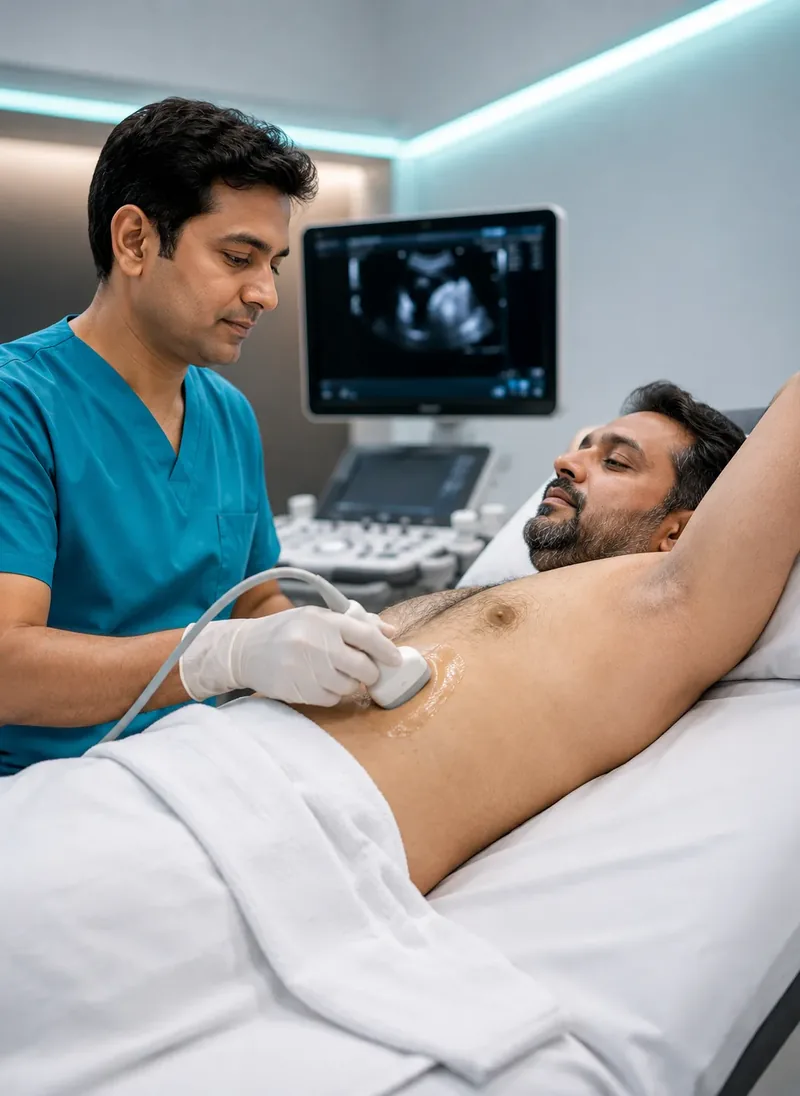
Liver elastography in Bopal, Ahmedabad
Liver elastography measures how stiff your liver tissue is. Healthy liver is soft and pliable; as scarring develops it becomes progressively firmer, and that stiffness can be measured from outside the body using ultrasound. The result is a number in kilopascals that corresponds to a fibrosis stage.
It matters because liver scarring is largely silent. Fibrosis develops over years without symptoms and often without abnormal liver function tests, and by the time either appears a great deal of damage may already have occurred. Elastography detects the change while it is still early — painlessly, in under twenty minutes, and with nothing injected.
What liver elastography measures
A probe placed over the right side of the rib cage sends a painless mechanical pulse into the liver. That pulse travels outwards as a wave, and the speed at which it moves depends on the stiffness of the tissue it passes through — faster through scarred, firmer tissue, slower through healthy tissue. The system measures that speed and converts it to kilopascals.
This is a different question from the one a standard scan answers. A routine sonography shows what the liver looks like — its size, texture, and whether fat or a lesion is visible. It cannot grade scarring from appearance alone. Elastography supplies that missing measurement, and the two are often performed in the same appointment.
Who is advised a liver stiffness test
Elastography is used both to assess liver disease at diagnosis and to monitor it over time, and it is increasingly requested for fatty liver — the most common liver condition seen in practice.

Common reasons for referral
Where liver disease is known or suspected, stiffness tells your doctor how far it has progressed.
- Fatty liver found on ultrasound, including non-alcoholic fatty liver disease
- Chronic hepatitis B or C, at diagnosis and during treatment
- Alcohol-related liver disease
- Persistently abnormal liver function tests without a clear cause

Why it is repeated
Because the test carries no risk, it can be used to track change rather than taken once.
- Monitors whether fibrosis is improving, stable or progressing
- Shows the effect of weight loss, treatment or reduced alcohol intake
How the test is performed
You lie on your back with your right arm raised above your head, which opens the spaces between the ribs and gives the probe a clear window to the liver. Gel is applied and the probe is positioned over the lower right rib cage. Several readings are taken from the same region and the system reports a median value with a measure of how consistent the readings were.
Nothing is injected, no radiation is involved and no sedation is needed. Most patients feel only the pressure of the probe and, with some systems, a light tapping sensation. You can eat and return to normal activity immediately afterwards.
Preparing for your elastography appointment
Come with an empty stomach. This is the one preparation step that genuinely affects the result — eating increases blood flow through the liver, which raises the measured stiffness and can push a borderline reading into a higher band. Water is allowed, and regular medicines should be continued unless your doctor has said otherwise.
Wear loose clothing that allows easy access to the right side of the upper abdomen, and bring any previous liver ultrasound reports, liver function tests or hepatitis results with you. Where a prior stiffness measurement exists, the comparison is often more informative than the new value alone.
Understanding your liver stiffness result
Your report gives a stiffness value in kilopascals and the fibrosis stage it corresponds to. Here is how that result is produced and read.
01
Multiple Readings
Several measurements are taken from the same region of the liver so that a single unrepresentative reading cannot skew the result.
02
Median Value in Kilopascals
The system reports the median of those readings along with a reliability measure showing how closely they agreed with one another.
03
Interpretation Against Your Condition
The thresholds separating fibrosis stages differ depending on the underlying liver disease, so the radiologist interprets your value in that context rather than against a single universal cut-off.
04
Same-Day Reporting
A Consultant Radiologist reviews the study and the report is issued the same day, in digital and printed form, for review with your treating doctor.
Frequently asked questions
A routine ultrasound shows what the liver looks like — size, texture, visible fat or lesions. Elastography measures how stiff it is. Fat can be seen on ordinary ultrasound but scarring cannot be graded from appearance alone, and stiffness is what reflects fibrosis. The two are often done in the same appointment.
Yes — come with an empty stomach. Eating increases blood flow through the liver and can raise the measured stiffness enough to affect the result. Water is allowed and regular medicines should be continued unless your doctor advises otherwise. We confirm the exact fasting duration when your appointment is booked.
For many patients it does, and it has substantially reduced the need for biopsy in assessing and monitoring fibrosis because it can be repeated without risk. Biopsy is still needed in some situations — where the cause of liver disease is unclear, or where results conflict with other findings. Your treating doctor decides.
About fifteen to twenty minutes, and it is not painful. You feel the probe pressing against the ribs and, with some systems, a light tapping sensation. No needles, no injection, no radiation and no sedation — you can eat and resume normal activity immediately afterwards.
It is one of the most useful tools available for exactly that. Stiffness begins to rise before symptoms appear and before liver function tests become abnormal, so fibrosis can be identified while it is still potentially reversible — which is why it is increasingly used in fatty liver disease.
It depends on the underlying condition and how treatment is progressing. Because the test carries no risk, repeating it is straightforward, and annual monitoring is common in chronic fatty liver disease and treated viral hepatitis. Your treating doctor sets the interval.