
 MRI • CT • Sonography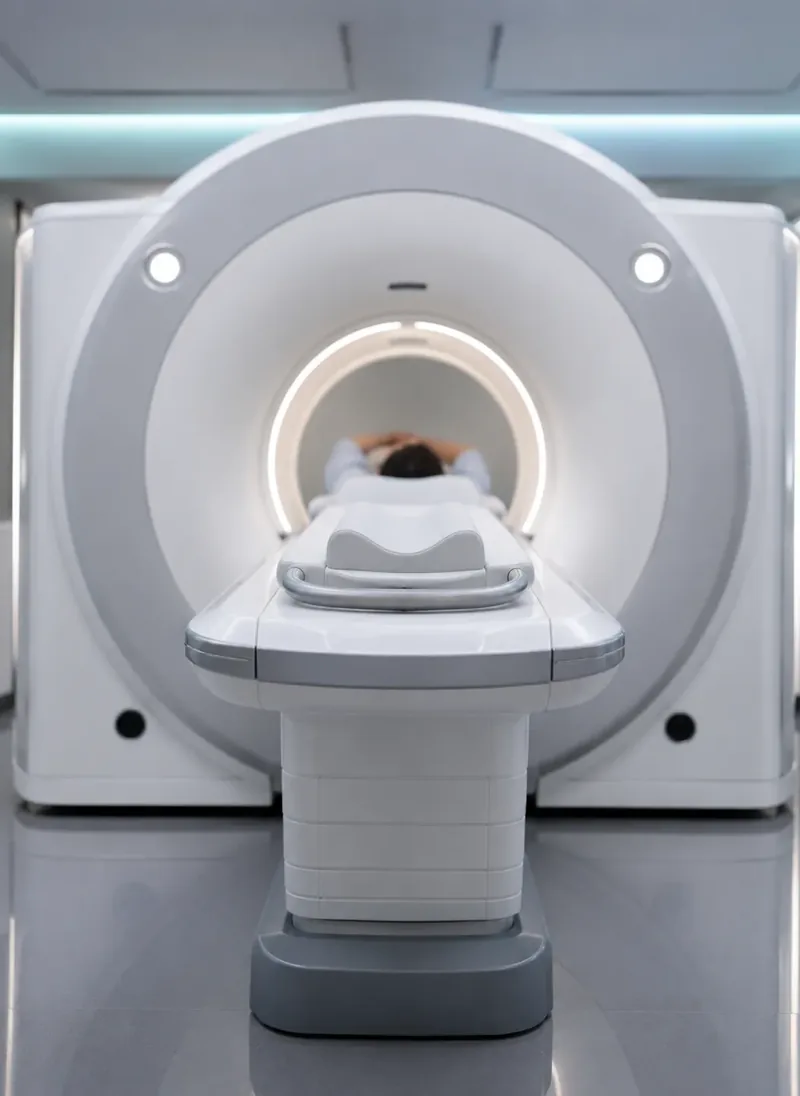
The CT calcium score scan, step by step
Patients booking a CT calcium score usually want to know one thing first: what is actually going to happen in the room. The short answer is that this is one of the least demanding scans in cardiac imaging — nothing is injected, nothing is swallowed, and you are on the table for a matter of minutes.
This page covers the procedure itself: the protocol, the equipment, the radiation dose and how to prepare. If you are trying to work out whether the test is right for you, start with CT coronary calcium score. If you already have a result in hand, the calcium score test page explains what the number means.
How a CT calcium score scan is performed
You lie on your back on the CT table. Three ECG electrodes are placed on the chest so the scanner can time its acquisition to the quietest part of your cardiac cycle — the brief pause when the heart is between beats. The table then moves you through the scanner ring while you hold your breath for a few seconds.
That breath-hold is the only thing asked of you, and the radiographer will rehearse it before the scan starts. Keeping the chest still stops calcium deposits from blurring across slices or being counted twice, which is what protects the accuracy of the final score.
The protocol and the equipment
Calcium scoring uses a narrower, lower-energy protocol than a standard chest CT, because it only has to detect dense calcium rather than resolve soft tissue detail.

A dedicated cardiac protocol
The acquisition is triggered by your own ECG trace rather than running continuously.
- Imaging synchronised to the resting phase of the heartbeat
- Thin slices covering the heart only, not the whole chest

Dose kept deliberately low
Automatic dose modulation adjusts output to your body habitus rather than using a fixed setting.
- Scan range limited to the cardiac field
- Exposure confined to the gated window in the cardiac cycle
No contrast injection, no fasting — how to prepare
Preparation is minimal, and most of it concerns what you wear. Metal across the chest — zips, hooks, an underwired bra, a chain — produces bright streaks on CT images that can sit directly over the arteries being measured. Anything unsuitable is swapped for a gown on arrival.
Eat normally and take your usual medicines. Because nothing is injected, there is no need for a kidney function test beforehand and no contrast allergy to consider. The one request we do make is to skip tea, coffee and other caffeine on the morning of the scan, since a steadier heart rate produces cleaner images.
Radiation dose and safety
A calcium score uses ionising radiation, but the dose is small by CT standards — considerably lower than a routine chest CT, because the scanner covers a short range and only exposes during the gated window. Dose modulation adapts the output to your build rather than applying a fixed setting.
The study is not performed during pregnancy. If there is any possibility you may be pregnant, tell the radiographer before the scan so an alternative can be discussed with your doctor.
From arrival to report
A typical calcium score appointment at our Bopal centre runs as follows.
01
Check-In & Change
Registration takes a few minutes. You change only if your clothing carries metal across the chest — no gown is needed otherwise.
02
ECG Electrodes & Positioning
Three electrodes are placed on the chest and you are positioned on the table with your arms above your head. The radiographer rehearses the breath-hold with you.
03
Gated Acquisition
The scan runs during one breath-hold lasting a few seconds. You will hear the scanner move but feel nothing at all.
04
Quantification & Same-Day Report
Images are processed and reviewed by a Consultant Radiologist, and the report is issued the same day. You can resume normal activity immediately, including driving.
Frequently asked questions
Expect about fifteen minutes in the department and roughly ten in the scan room. Most of that is positioning and attaching the ECG electrodes — the image acquisition itself lasts only a few seconds, during a single breath-hold.
No. Calcium is dense enough to be visible without any dye, so this is a non-contrast study. There is no cannula and no injection, which also means no kidney function test beforehand and no contrast allergy risk to consider.
Yes, for a few seconds, and the radiographer will practise it with you first. Keeping still stops calcium deposits from blurring across slices or being counted twice. If holding your breath is difficult, say so — the scan can be adapted.
Comfortable clothing with no metal across the chest. Zips, hooks, underwired bras and necklaces all create bright artefacts that can obscure the area being measured. If your clothing is unsuitable, you will be given a gown.
Yes to both — no fasting is required and regular medicines should be continued as normal. The one common request is to avoid tea, coffee and other caffeine on the morning of the scan, since a steadier heart rate produces cleaner images.
It is safe with all three, but often no longer the right test. Stents and surgical clips register as dense material and distort the score, and in patients already treated for coronary disease the result rarely changes management. Tell us about any cardiac implant when booking.